


In 2025, PAMMTV launched INTERTIDAL, a biennial exhibition celebrating South Florida’s contributions to contemporary media art, featuring five landmark video works that expand the boundaries of media art through the lens of Miami. This interview series is one of four bringing together artists featured in INTERTIDAL, whose practices reflect the forces that shape our shared and personal worlds. In this installment, hear directly from artists LIZN’BOW.
Interview Date: May 23, 2025
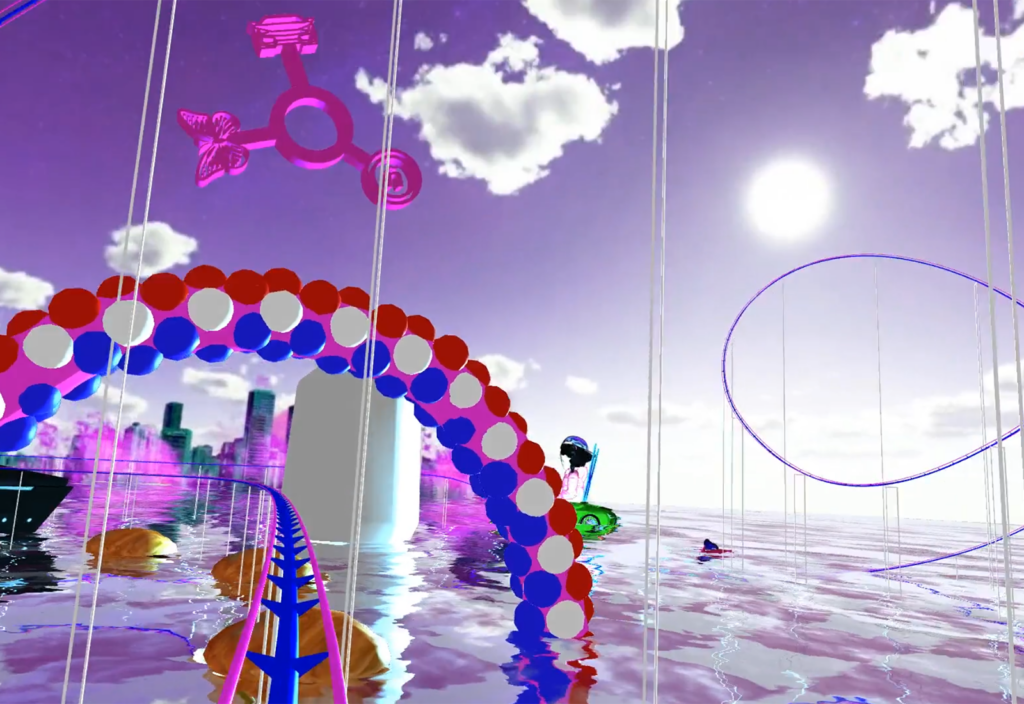
Pérez Art Museum Miami (PAMM): I would love for you two to introduce yourselves telling us how did you two met and also talk about the story behind the piece Niñalandia Skycoaster (2024), featured in PAMMTV’s INTERTIDAL 2025.
Liz: Hi, I’m Liz.
Bow: and I’m Bow.
Liz’Bow: We are Liz and Bow.
Liz: We met 10 years ago
Bow: Right, so I was at this party working as a human lamp when we met. It’s a job I do occasionally where I wear a lamp on my head, stand completely still, and basically only interact with people by making eye contact with them. So, Liz and I met when I was working that job.
Liz: I had gone to Chicago for the first time after doing an artist residency nearby. I went to this party and saw this lamp across the room, and I was like, “Who’s that lamp?” I went up to Bow and started talking to them for hours. But like Bow said, they could only make eye contact; they couldn’t respond. I kept bringing people over, saying, “Have you seen this lamp? Let’s see if we can make the lamp break from not talking.” Eventually I had to leave, and Bow was still working as the lamp, so we never actually got to talk. But I couldn’t stop thinking about the lamp. I had a friend from the residency, Keioui Thomas, who put me in contact with Bow, so I messaged Bow the next morning and invited them to a performance I was doing with the Poncili Creación twins and Keioui. Bow said, “I already have plans.” It turned out Bow’s plans were to come to our show—they just didn’t know it was the same show. When Bow and I finally got to talk, we immediately made a spreadsheet of all these things we wanted to work on together. It felt very natural, but also completely unnatural, because who meets someone and immediately starts making a giant list of things they want to create together? It was kind of a magical moment.
Bow: As Liz said, we made a spreadsheet, and there were 10 or 20 things on there, and then a month later I flew to Miami, and we started working on them, and now, 10 years later, we have done almost all those things. The list was full of a bunch of different kinds of ideas, and one of the first projects on it was working with kids through museums. Liz had a connection with The Bass Museum of Art in Miami, so that gave us a foot in the door to start doing these new media identity workshops where we would ask the kids questions like, “What are things in the world that aren’t real?” and “What would the world be like if they were real?” Then we would have them draw those things, use objects as clothing, pick new names and identities, and photograph them in front of a green screen as their new selves.
Liz: We would host youth workshops in partnership with art institutions, and the kids would have a lot of fun. Then Bow and I would go home and make these maximalist collages or video works that would take forever to make, and it really makes no sense to do such complicated art pieces as part of a kid workshop series. These pieces we would create after the workshops were a lot of work, but they were fun and really interesting.
Bow: Right, we’d come back to them with a new image created by combining their ideas, drawings, and photos into mixed reality portraits that would convey something new about everything they came up with, and they would react to it and understand, or see themselves in a new way, maybe. And this was the first step in creating Niñalandia, which is like an ever-growing expansive world between reality and fiction based on all the projects Liz and I have been doing with each other and with our community for the 10 or so years we’ve known each other.
Liz: Exactly. It’s this world we’ve been building for years. It’s an ongoing project, so it’s not really new; we just keep adding more to it. Now we’re referring to it as a pro-pocalyptic universe, a future where instead of waiting for some apocalypse to end everything, we imagine how people adapt, take care of each other, and keep finding ways to have joy.
Bow: Yes, and it first started coming together in this current form, the form it shows up as in the Niñalandia Skycoaster, as a video backdrop for one of our shows, then over time, it transformed into a whole landscape that expanded beyond the limits of that medium into physical and virtual environments, three-dimensional objects, etc. It absorbed all these aspects of our lives and then at the same time offered them a vehicle to transform and become something else.
Liz: Yeah, we don’t want this universe to exist only digitally, so we keep finding ways to bring things out of it and into the physical world. There’s so much inside Niñalandia that it can become all kinds of things. We can literally go shopping for new ideas inside our own videos and say, “Oh yeah, that animation would be cool as a sculpture.”
Bow: Right. And a big part of the motivation is just bringing all these elements into the real world in some way, you know, like making the world a little more pink, making it a little more femme, filling the clouds with milk, bringing all these aspects from our universe into the real world and allowing them to be filtered by that world into something new.
PAMM: How do you start to conceptualize a new project? Is there a specific moment or idea that ignites the creation of your work, or is it a more organic process that develops over time?
Liz: Our process is very collaborative, organic, and past ideas feed into new ones that develop over time. Our work is a growing collage of our shared life together. There’s a thread between the way kids think and the way we want to think. Obviously, we’re not as free as children, we’re adults, we’ve been jaded a little bit by life, but we try to hold onto that openness and that sense of possibility.
Bow: Mhm. And Liz and I are each bringing our own thing to our collaborative practice. For me, I was already doing a bunch of experimental business projects, or art projects that sort of work directly within the economy and capitalism and the way we imagine how things can be represented. With the kids, we would think of some kind of media format, for example, “like OK, let’s do a music video; let’s do a commercial, etc.”
Liz: One of the early projects with kids was called Girl Power with LIZN’BOW. When we worked with them we would start with a familiar format and say, “Okay, this time we’re making a commercial,” or “We’re making a talk show with LIZN’BOW.” We even did a live talk show with kids in Tampa.
Bow: Yeah, we would use a known media format as a reference, and then, from that point, we would allow whatever our collective understandings of that thing were to work together to form something weird, absurd, crazy, etc. In that way, it would be kind of a media criticism practice with kids.
Liz: We still work that way now. We’re currently making a short web series, Olguita la del Barrio, that stars my abuela, and we’re working with the language and structure of a telenovela. We’re both performance artists, but we come to it from different places. I come more from theater, and Bow comes from new media and performance art. But I never totally fit into theater anyway. My ideas were always a little stranger than the other people I was in school with. Later, most of my friends were artists, and eventually I realized I was an artist too. I also have a film background from working on movie sets. But in our collaboration, we like to say Bow is in charge of the tech department, and I am in charge of the live department. Bow handles a lot of the technology, digital images, animations, etc. They code, they’re a self-taught coder, and they went to school for digital art. I handle a lot of the directing, writing, and producing. Then both of us riff off each other for new ideas, concepts, and development of our different projects. Creatively, I’ll often start writing a script or a song, then Bow comes in and edits it, and sometimes we’ll shoot a video idea together, and Bow will transform it visually through the edit. Our roles overlap, but we also know each other’s strengths. We’ve been doing this together for 10 years, so there’s a lot of trust.
PAMM: The figure of the abuela (grandmother) appears frequently in your work. Can you talk about her, and how do you determine which visual languages or tropes to incorporate into your work?
Liz: When we worked with my abuela it was very collaborative, she had all these stories from her actual past mixed together with things she had seen on TV, and she would just improvise. Her real story already sounds a little like Thalía’s María la del Barrio. In her real life she didn’t end up marrying a rich person, but she was an orphan, she grew up in an orphanage in a Catholic Church, and she was about to become a nun when she randomly met abuelo and left. So we started mixing her actual life with the script for her telenovela.
Bow: Right, and one example of that is that she actually had a big crush on Otto von Schirach, our friend and Miami musician who was forty years younger than her.
Liz: Yeah. After abuelo passed, I started throwing her birthday parties with my friends because I wanted to make her happy and give her something to look forward to every year. She ended up developing a crush on our good friend Otto von Schirach really fast. Years later, when we were working on this project, we asked her, “Do you want him to be your boyfriend in the project?” And she said, “¡Claro!” That’s really how a lot of our projects come to be. We remix our actual lives, our family, our friends, our desires and fantasies, and other people’s desires and fantasies, all together. There are real things in there, but also things we wish were real or decide to make real within the work.


