


In 2025, PAMMTV launched INTERTIDAL, a biennial exhibition celebrating South Florida’s contributions to contemporary media art, featuring five landmark video works that expand the boundaries of media art through the lens of Miami. This interview series is one of four bringing together artists featured in INTERTIDAL, whose practices reflect the forces that shape our shared and personal worlds. In this installment, hear directly from artists LIZN’BOW.
To experience the full conversation, begin with part one. Continue with the second installment below.
Interview Date: May 23, 2025
PAMM: How do you determine what medium you’re going to use in your art? Let’s say you’re making commercials and you have a background in film and performance. How do you choose? How do you navigate that selection process in relation to the media?
Bow: So, we’re inspired by pop culture, but also by our friends. When we think of one of our friends, a family member, or someone who makes us think like: “How could we work with this person in a way that would be interesting or, maybe, change something about their life, our lives collectively, or the world?”, that can act as a starting point. And part of that process is thinking about what mediums or formats are currently relevant to that person or group of people. Then through the practice of working with them in that medium, the work can go further, because it’s more immediate and personal.
Liz: Bow and I love experimenting in all mediums, so it all depends on the opportunity, the site, and whatever new idea comes to us. We always want to try something different. I want to make bigger public art pieces. We are in conversation with Times Square Arts in New York about having a very big LIZN’BOW Times Square takeover next year. I would also love to create a playground one day, the LIZN’BOW Playground. I haven’t seen that opportunity yet, but it’s been in my mind forever. Our brains just want to create a lot of different things to share with the world.
Bow: Yes, It’s an ongoing project, and we’re just adding more to it. We have lots of ideas of how to make it more of a universe in that way.
PAMM: How has your journey as a duo been in developing your style and artistic identity? What has led you to where you are today? What role does Miami play into your identity as makers?
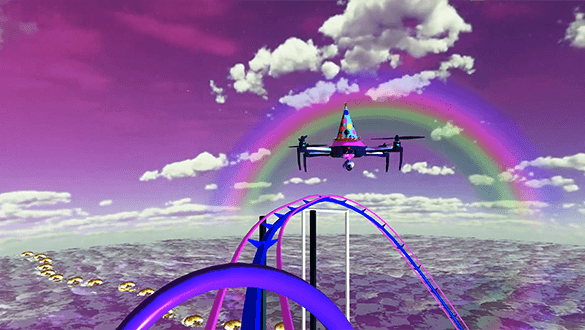
Liz: We live here. I’m mostly from here, I was born in California, but I’ve lived in Miami since I was 11. This is our home. Obviously, we have other influences as well, but Miami is the environment we’re living and working in. We use a lot of actual Miami imagery in our videos and collages. When you see buildings going by in Niñalandia Skycoaster, those are actual Miami buildings. Sometimes Miami enters the work simply because it’s around us, but we’re also very intentional about it.
Bow: Right, there’s a lot of Miami influences that show up in our work both incidentally and intentionally. Like in Niñalandia, there’s an archipelago of cuban pastelitos, a cow unicorn riding a jetskii, a pink iguana using a water jetpack, perreo dancers, cute surveillance drones, etc.
Liz: The early-2000s is an era we reference a lot directly and indirectly in our project too, probably because those were very formative years for us. There’s nostalgia in our work, but we’re not only looking backward. We’re looking at the past, the present, and the future at the same time. Our project is very much about imagining a future, but we’re not interested in imagining that future by erasing where we came from. So Thalía can be there, early reggaeton can be there, our families and memories can be there, but there’s also something we haven’t seen yet, something new that we’re creating.
Bow: And the way I work digitally in this practice is like, there’s a lot of pulling images from different places and combining them into new things. It’s like working with this whole ocean and history of images. Some of that is just like the whole Internet, and some of it is more personal and specifically where we’re from. So you’ll see everything from family footage re-interpreted and incorporated in new ways, to stock photos pieces chopped up with little bits of watermark remaining on them.
Liz: And our friends are part of it too, and even the way we dress. Bow and I each have our own distinct style, and that enters the work. Niñalandia has a lot of early-2000s references, which also connects to that early reggaeton era, but there are also things from right now, things that aren’t from any particular time, and a lot of pop-star aesthetics. We’re pulling from a lot of different references.
Bow: Yep. and at the same time, I feel like we don’t always have an explanation for what we do, but we know that there’s a reason. It’s a feeling-based thing.
PAMM: For our final question, how would you like the public to engage with the work?
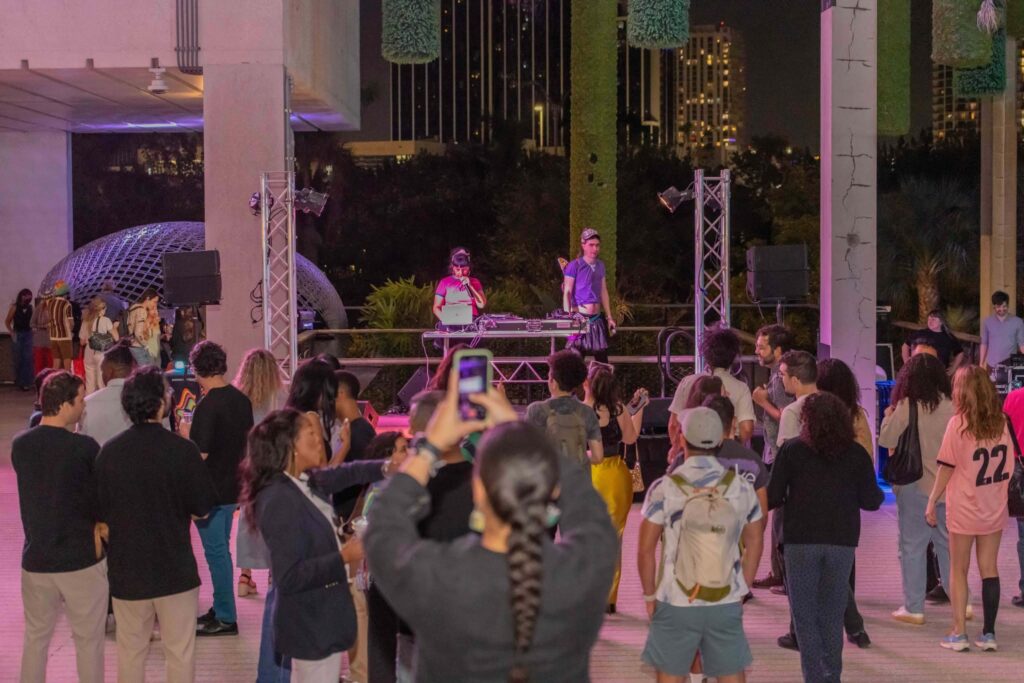
Liz: It’s for everyone. It’s for the bro next door who sees us perform our reggaeton songs and high-fives Bow while they’re wearing a skirt, and it’s for the art critic writing in a book about how the leche is smashing all the patriarchy. We would want there to be space for everyone to enter it, for the abuelas, for the kids, for everyone.
Bow: Yeah, we’re not trying to be just in a bubble. Why we like working with communities is because then we’re not just in the museum art world bubble. Even though all sorts of people go to museums, which is great too, there’s also a lot of people that can’t or won’t ever go to museums. So, we try to make sure it operates on a lot of different levels at once. A good example is the music project, Niña, that project is one of the most popular because anyone can understand it, and yet at the same time we hope it gets people thinking in ways that are different than what they’re used to.
Liz: I don’t think we’re making the work to be received in one particular way. Like Bow said, when we can, we want to give people a platform, people who maybe haven’t had the opportunity to perform, people who have a story they want to tell, or people who just want to be part of it and have a good time. And for our audiences we are carving out a space for joy, humor, and connection.
Bow: Yes, we really like to bring all kinds of people in because it’s an opportunity to weave new ideas into how we see the world and bring them into maybe new understandings through encountering something hybrid that’s celebratory, critical and open to new possibilities all at the same time.


