Guillaume Apollinaire Peintures de Léopold Survage; Dessins et aquarelles d’Irène Lagut (Paintings by Léopold Survage; Drawings and Watercolors by Irène Lagut) 1917
© Guillaume Apollinaire

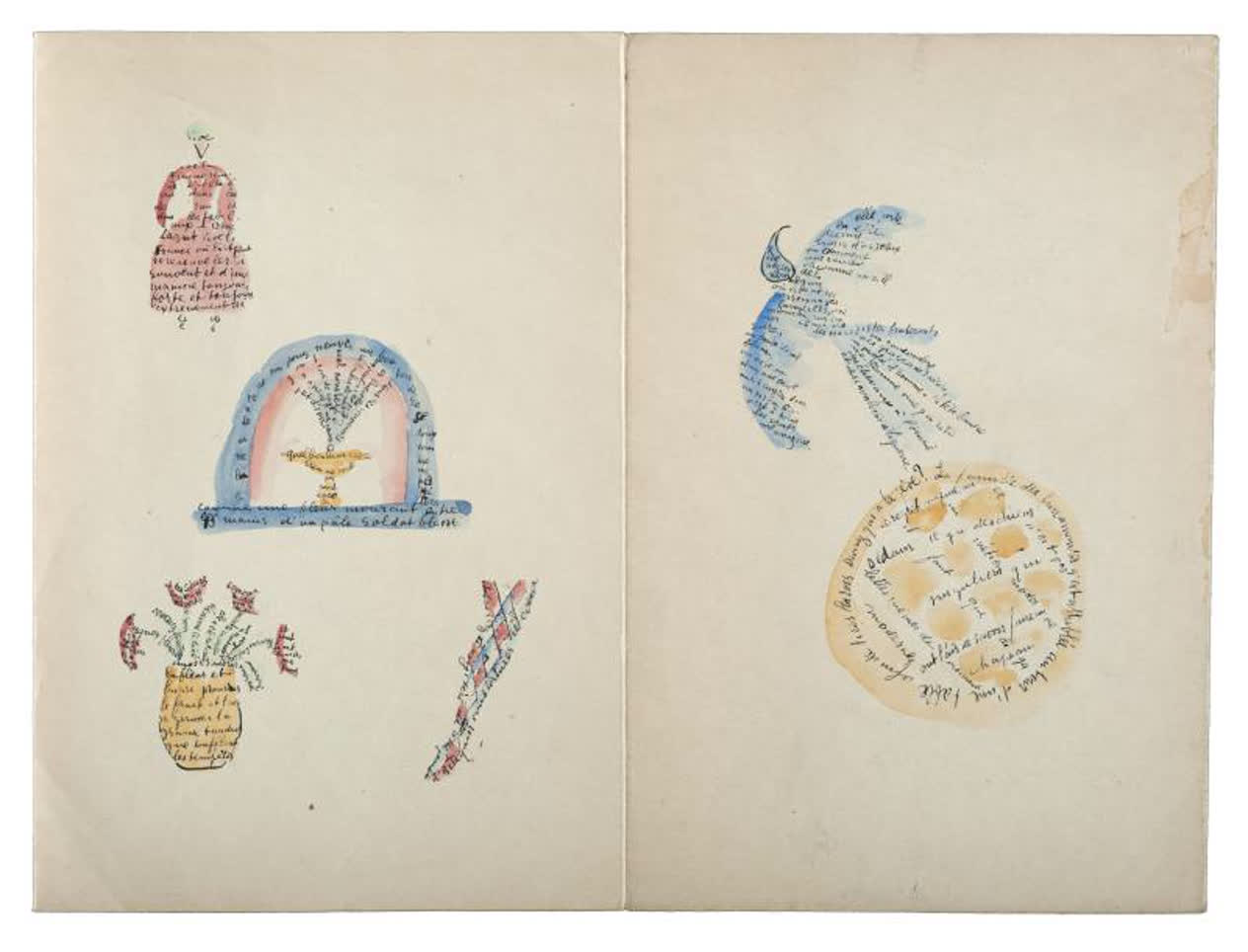
Guillaume Apollinaire was a profoundly influential art critic, theoretician, and advocate of the early 20th-century Parisian avant-garde. He was also one of the first practitioners of modern visual poetry. In 1917, Apollinaire organized an exhibition of works by Léopold Survage and Irène Lagut. This exhibition catalogue includes two introductory statements and 13 visual prose poems, which expound on the artists’ works while taking the form of horses, clocks, flowers, and other pictorial motifs. The result combines Apollinaire’s concept of “critical poetry” with his earlier experiments merging word and image, which he had explored since 1913 in poems subsequently published in the compilation Calligrammes (1918). This rare edition of the catalogue is among only ten copies the author tinted by hand with watercolor. Apollinaire is also considered one of the forefathers of the Surrealist movement, having been a major influence on the young poets who later formed the nucleus of the Surrealist group, such as Louis Aragon, André Breton, and Philippe Soupault.
Identification
Title
Peintures de Léopold Survage; Dessins et aquarelles d’Irène Lagut (Paintings by Léopold Survage; Drawings and Watercolors by Irène Lagut)
Production Date
1917
Object Number
2016.503
Credit Line
Collection Pérez Art Museum Miami, acquired from The Sackner Archive of Concrete and Visual Poetry, with support from the John S. and James L. Knight Foundation. Gift of Ruth and Marvin A. Sackner
Copyright
© Guillaume Apollinaire
https://live-pamm-dot-org.pantheonsite.io/en/artwork/2016.503
Copy artwork link
Physical Qualities
Medium
Softcover exhibition catalogue with 12 lithograph pages tinted with watercolor
Dimensions
11 x 7 1/2 x 1/4 inches
Visual Description
Peintures de Léopold Survage; Dessins et aquarelles d’Irène Lagut by Guillaume Apollinaire is a concrete poem from 1917. It is a Softcover exhibition catalogue with 12 lithograph pages tinted with watercolor. It measures eleven inches by seven and a half inches by a quarter of an inch. Concrete poetry, also sometimes known as visual poetry or shape poetry, is focused on the visual effect that words have when they’re arranged in a certain way. The selection being described is of two pages, arranged horizontally next to each other. The first page consists of word drawings of a women in a dress, a fountain, flowers in a vase, and flowers, colored with water color. The second page consists of word drawings of a bird and a pie, colored with water color. Starting at the top left of the painting and moving downward, the picture consists of a series of words arranged to appear as a woman in a dress. Her head is a small head with a yellow featureless v shaped face, and medium length green hair. She wears a long-sleeved red dress. The lower section of her dress is very wide, and her feet are a few black letters arranged as two v shaped shoes. The woman is colored with transparent water color over black words. Beneath the woman and to her right is a frontal image of a fountain. The fountain is composed of words painted yellow with blue water shooting out from it. Above these streams is a red and blue rainbow. The top of the rainbow consists of words arranged in a blue arc. The inside of the arc contains a smaller red arc. Unlike the first arc, this one does not contain any words. Underneath the fountain is a wide blue base with words inside of it. Beneath this fountain are two images arranged next to each other horizontally. The image on the left is a word drawing of a vase that contains flowers. The vase is yellowish orange. Within the vase are four flowers. The petals are red, and the stems are thin and green. The flowers are loosely fanned out, with seven pieces of foliage that are shorter than the flowers. They are mostly arranged between the flowers with the exception of two pieces that hang off the top right of the vase. The bottom section of the vase is outlined by a black line. The image to the right of the vase is a diagonal arrangement of flowers, stems and foliage. The top and bottom of this image are horizontally aligned with the top and bottom of the image to the left of it. The flowers are composed of alternating images. The top of the floral arrangement has two flowers next to each other. The petals are red, and the stems are green. From the top to bottom, the stems of flowers are weaved together. The line is composed of a top to bottom pattern alternating between one rose, and then one section of green stems as tall as the previous flower. This pattern repeats itself five times. The second page, arranged on the right of the first, contains two word drawings, each slightly larger than the ones on the first page. The two drawings are centered. The first image is a blue bird and the bottom image is an image of a beige colored pie. The top image of the bird appears as if it is viewed from underneath the bird as it flies over the viewer’s head. The bird is arranged in a diagonal arrangement that slightly leans to the left. The top of the word drawing is a profile of the head of the bird. The wings of the bird are spread symmetrically to the left and right of the body of the bird. Beneath the body of the word is the tail of the bird. The bird is completely colored by a transparent wash of blue water color. The image is opaquer at the top of each wing, with the top section of the top of the left wing being slightly darker than the one on the right. Unlike the view of the bird, the image of the pie is presented in an aerial view. The circular edges of the pie features words arranged in one circle. The center of the pie is composed of a grid of intersecting diagonal lines. From the top to bottom, there are four rows composed of these diamond-like shapes. The diagonal lines feature words with no water color painted on them, however the space between the lines feature no words. These spaces are composed of a beige pie. The paper that the poems are drawn on is a beige color. The upper right corner of the second picture contains a brown stain on the right edge of the paper.