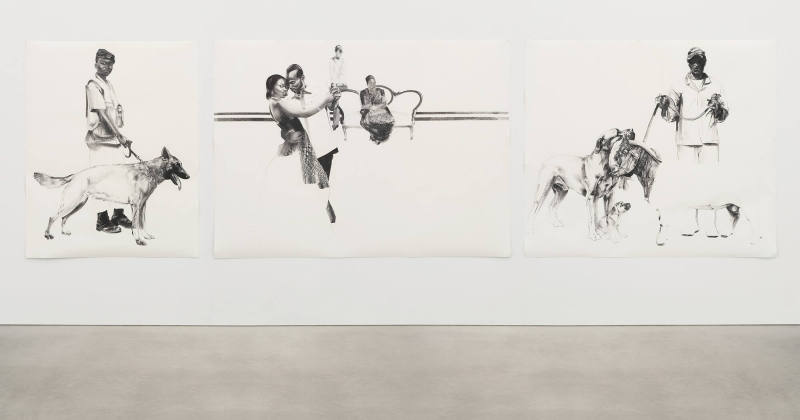
Meleko Mokgosi Terra pericolosa III (Dangerous Land III) 2015
© Meleko Mokgosi. Courtesy the artist and Jack Shainman Gallery, New York

Meleko Mokgosi’s subtle yet powerful work harnesses the traditions of Western European art as a tool with which to level sharp political critiques relating to contemporary sub-Saharan Africa. Combining a high degree of artistic skill with a poetic, open-ended approach, the artist shines a light on some of the most deeply entrenched socioeconomic dimensions of his home region while engaging themes related to its current postcolonial condition.
Terra pericolosa III features what seems at first to be three wholly unrelated vignettes. The composition features a central image that references the past, flanked by two images that loosely bring to mind the political tensions and chronic violence with which present-day Africa is often related. Mokgosi compounds this ambiguity using formal means, setting his figures amid broad fields of blank, open space. This compositional device implies a reference to cinema, with its lapses in time separating distinct scenes. It also conjures the well-worn trope of the unfinished painting, which functions here as a signifier for an unfinished national/regional/continental history. Through this allusion, Mokgosi signals a perspective that views colonialism not as a terminal phase that has already receded into history, but as an experience of living memory—a condition in which the past, present, and future continuously intermingle.
Identification
Title
Terra pericolosa III (Dangerous Land III)
Production Date
2015
Object Number
2017.220
Credit Line
Collection Pérez Art Museum Miami, museum purchase with funds provided by PAMM’s Collectors Council
Copyright
© Meleko Mokgosi. Courtesy the artist and Jack Shainman Gallery, New York
https://live-pamm-dot-org.pantheonsite.io/en/artwork/2017.220
Copy artwork link
Physical Qualities
Medium
Charcoal on paper
Dimensions
72 x 237 inches
Visual Description
Terra pericolosa III by Meleko Mokgosi is a three-panel piece. It is made of charcoal on paper and measures approximately 72 x 237 inches. It is hung in landscape orientation, meaning its longest side runs parallel to the ground. There is no frame for the three paper panels. The three panels are presented with a few inches gap between each panel. The center piece is an illustration of a couple dancing in a ballroom setting, or likely a fancy home gathering. The couple sway slightly to the left with the woman’s head pressed against her male partner’s head, while her body tilted at an acute angle of roughly 50 degrees bending at the waist where her partners hand awaits to support the tilt. His hands fade, not fully illustrating the fingers. The artist leaves the bottom portion with just minimal lines to imply boundaries yet not completing or closing the composition. Rather allowing the audience a peek into the process of the sketch. The man wears a white tuxedo suit and white shirt. The woman wears a black strapless tube top dress with a loose black and white long patterned skirt. Both male and female have dark tone skin with faces facing the audience and light areas on the face indicating ceiling lighting from above striking the upper forehead and cheek bones. The man has black pants that are overlapped by her dress skirt with just a sliver of the skirt illustrated giving a glimpse of the seemingly wide span of the twirl of the skirt in motion. The room is mainly empty, whitish unclaimed unmarked space, with a love seat sized sofa in the center. The left-hand side of the sofa is overlapped by the left shoulder of the man with his back to the woman seated on the sofa lounge chair. The woman’s extended right arm rests in the poise cradle of the man’s left hand which also overlaps the farthest left portion of the love sofa. The two canvases to the left and the right of the center image are both of men and animals. The left is a man with a German shepherd dog on a leash. The man is in military or police attire with a barrette to imply French influence. The dog is closer to the audience in a lower position on the paper canvas. The image of the dog is of a profile of the animal facing right. The man is holding the leash in his right hand. The man’s right arm is also extended pointed to the right. With his face turned to the audience giving a full view of his face. The man’s feet and boots peak from under the dog. The image to the right is of a man and two animals one is a dog and the other is a sheep. The dog looks to be an unidentified mixed breed. Likely a retriever and or German shepherd. The dog is facing right and engaging with the sheep. The sheep is facing left towards the dog face to face. The dog is to the left of the man who holds a leash attached to the sheep. The sheep stands in front of the man blocking his legs. The dog’s face is blocked by the face of the sheep. The overlap of the two animals seems that they are in an embrace yet the scale of the two animals shows that this is an optical illusion. The animals are in fact farther apart than perceived. The man wears a long sleeve coat with the top buttons unbuttoned forming a V-neck. He wears pants and boots that peek from under the sheep. Upon second look there is a puppy seated between the dog’s front legs. The puppy is seated facing up at the sheep. The head of the sheep faces down as the dog’s head is above it and behind it, facing up. The man wears a baseball cap that shades his entire face which is all darkened with no visible features. All the figures are dark toned and all the images fade towards the bottom portion of the paper canvases. The feet of the man the feet of the dogs are all simple outlines of graphite on white paper. Little shading, little contrast. There is no background to these three figures. All white paper.