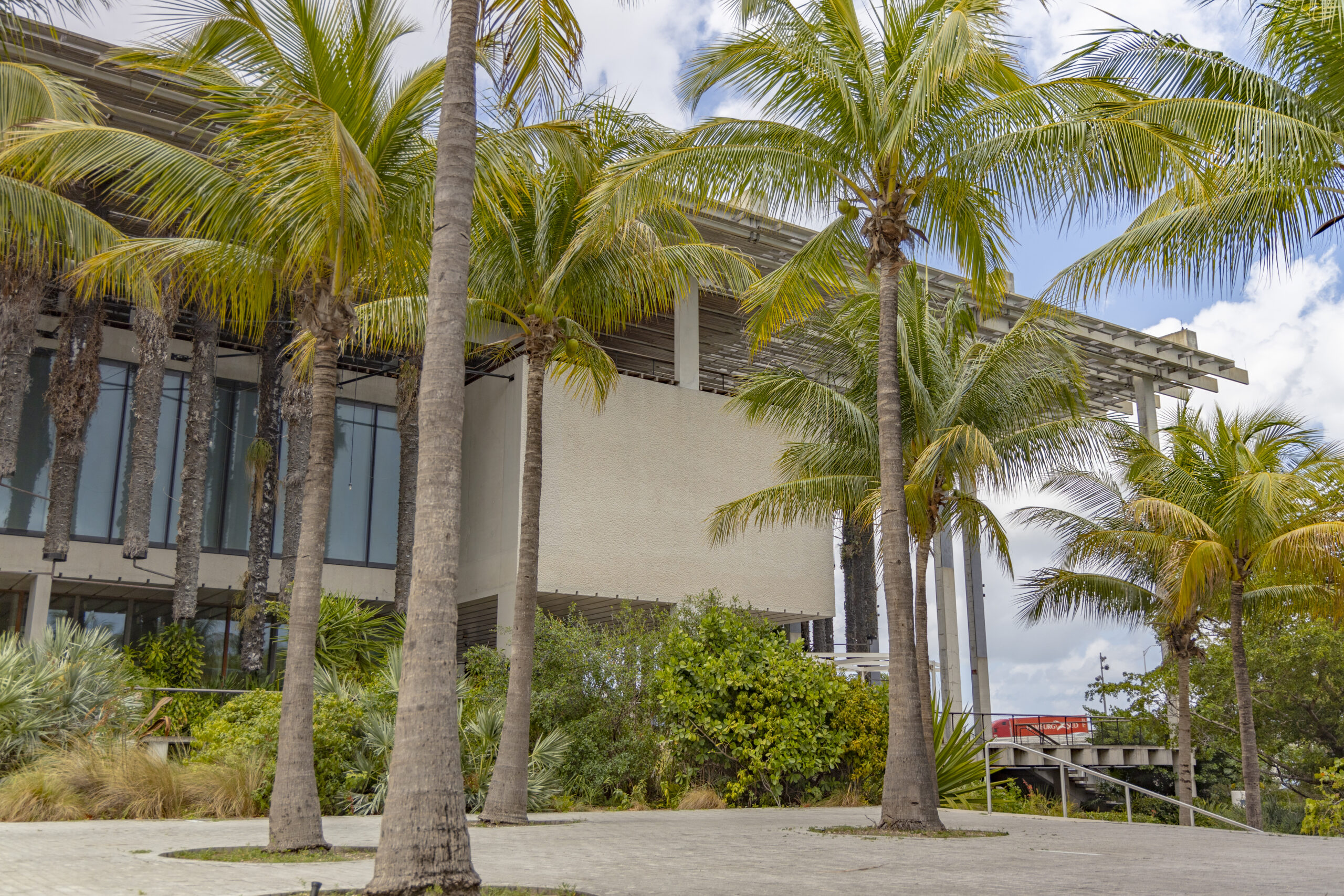
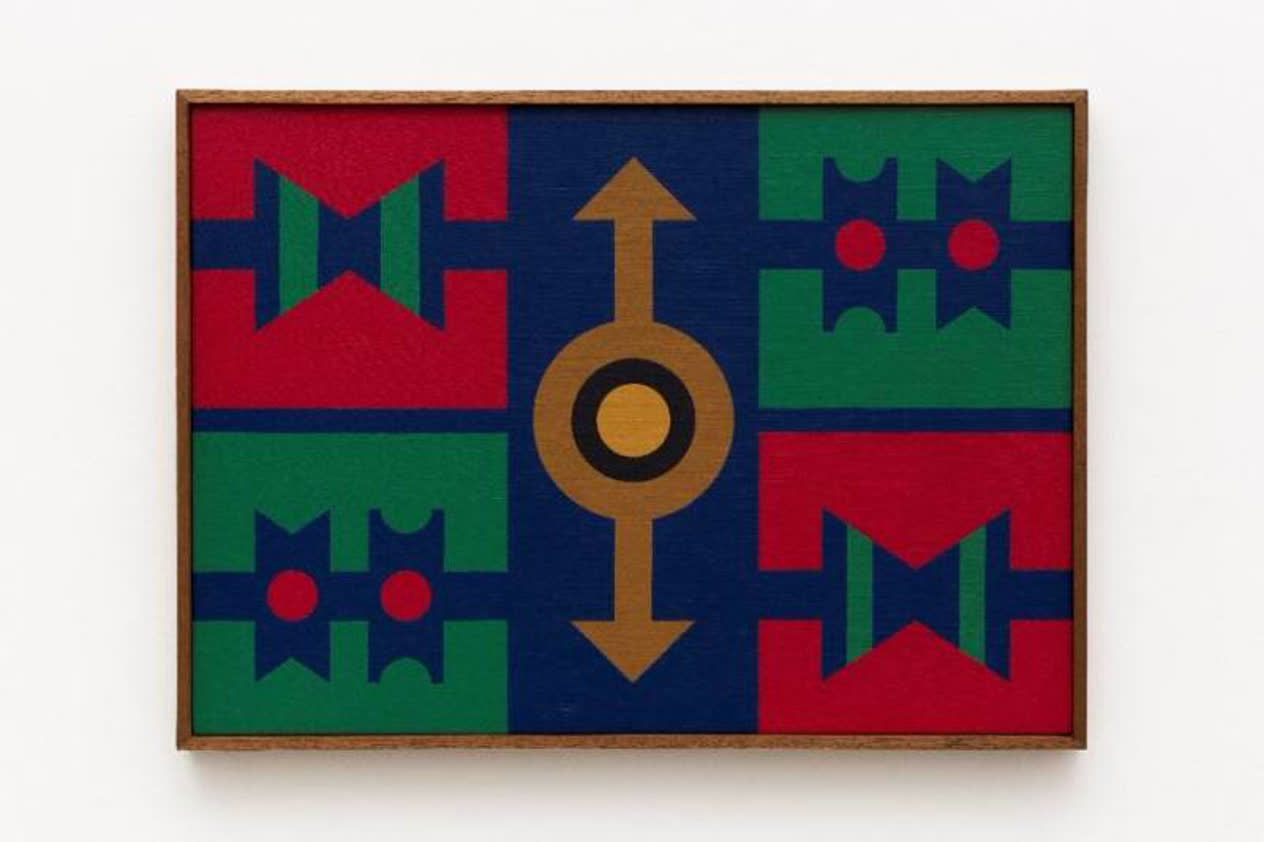
Rubem Valentim Emblema 79 (Emblem 79) 1979
© Rubem Valentim. Courtesy the artist and Mendes Wood DM São Paulo, Brussels, New York

Brazilian painter and sculptor Rubem Valentim began his career as a self-taught artist. In the 1950s, he started to observe the geometric symbols found in the realm of Afro-Brazilian religions and comparing them to modern, constructivist geometric forms. In this way, the artist delved deep into the European artistic language that controlled the art production in Brazil in order to generate a new language that blended geometric abstraction, constructivism, and concretism with drawings and diagrams of the deities from Afro-Brazilian religions—known as orishas.
In Emblema 79 (1979), Valentim creates a balanced and almost symmetrical composition with pure and strong chromatic investigations. The circular shape in the center is perhaps a reference to Orula—the orisha of divination and supreme oracle, representing wisdom and intelligence—while the triangles pointed at each other is a direct reference to Shango’s double-edged axe. Valentim fully and ambitiously undertook the renowned 1928 Manifesto antropofágico (Anthropophagic Manifesto) —an essential Brazilian modernist text by Oswald de Andrade (1890–1954) that suggests native intellectuals and artists to eat and digest the European influences in order to create hybrid Brazilian works that merged indigenous, African and European references. By following this thought process, Valentim executed a radical approach in the history of Brazilian art, subjecting the European language to an Afro-Brazilian culture while generating a powerful symbolic vocabulary of decolonization.
Identification
Title
Emblema 79 (Emblem 79)
Production Date
1979
Object Number
2020.010
Credit Line
Collection Pérez Art Museum Miami, museum purchase with funds provided by Jorge M. Pérez
Copyright
© Rubem Valentim. Courtesy the artist and Mendes Wood DM São Paulo, Brussels, New York
https://live-pamm-dot-org.pantheonsite.io/en/artwork/2020.010
Copy artwork link
Physical Qualities
Medium
Acrylic on canvas
Dimensions
19 3/4 x 27 1/2 inches
Visual Description
Emblema by Rubem Valentim is an abstract including only four colors. It is made of acrylic on canvas. It measures roughly nineteen inches by twenty-seven inches and is hung in landscape orientation, meaning its longest side runs parallel to the ground. The image is composed of four squares in each corner and a space in the middle where there is a large vertical symbol in a dark blue vertical rectangular space. The first square is red. It is placed in the top left-hand side of the composition. Under this red square is a green square in the bottom left-hand corner. The two squares are separated by a horizontal dark blue line. The dark blue bar is part of a bigger dark blue cross that is the center of this image. The vertical line from top to bottom is as thick as a third of the squares yet the horizontal line extending left to right is thin maybe a tenth of the surrounding squares. The right-hand side is also composed of two squares stacked on the other separated by the thin dark blue line. The top square is green, and the bottom square is red. This is the reverse of the left-hand side. The first square on the left-hand top corner has an image of two triangular arrows pointed at each other over lapping at the center. This arrangement creates a horizontal bow tie. The bow tie shape is cut out from the red square leaving the dark blue that separates the two squares to show through as a thick stripe on either side of a sharp-edged bow tie. The dark blue bow shape has a vertical green stripe on either side of the center creating a striped pattern. This same pattern is repeated in the red square on the right-hand side at the bottom of the composition. There is a slight difference with the striped pattern of the bottom red square. The green line on either side of the center blue strip is thinner on the bottom red corner than the upper left corner. This is the only visible difference between these two red squares. Down the center of the canvas is a vertical symbol painted in gold or a dull light brown tone. The top and bottom end are shaped as arrows and the center is a ring. This is one solid piece with a round black hole at center and a dot of gold color is at center of this black ring. This symbol resembles a compass as both ends have arrows pointing up and down and a center ring design like that of a compass. The middle portion of this work is colored navy blue, the same dark blue that fills the spaces between the red and green rectangular shapes on either side of this center piece. This composition seems to be a layered cut out design that uses dark blue as the background and foundation of the composition.