


The Bahamian artist’s most significant institutional presentation in the United States to date transforms PAMM’s waterfront gallery into a protective landscape of woven clay, bottle trees, and shells. On view October 1, 2026–August 1, 2027.
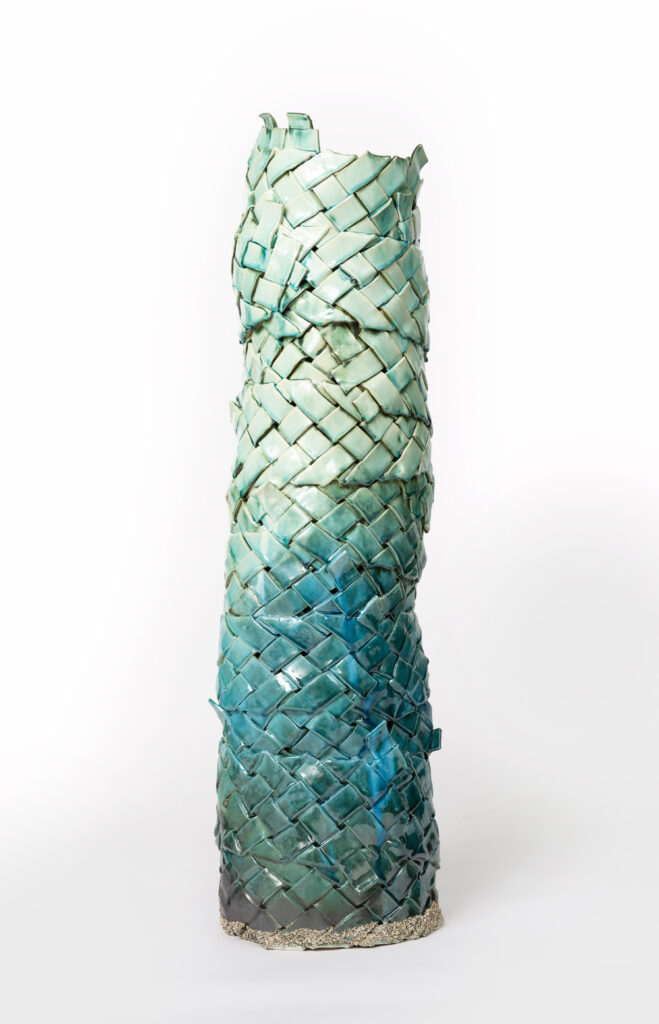
(MIAMI, FL — July 30, 2026) — Pérez Art Museum Miami (PAMM) is pleased to present Anina Major: The Sacred Mangrove, on view from October 1, 2026–August 1, 2027. The exhibition marks the Bahamian-born artist’s most significant institutional presentation in the United States to date and a turning point in her practice, expanding her woven ceramic sculptures into an environment where sculpture, architecture, and landscape operate together.
Conceived as a walkable ecosystem, The Sacred Mangrove brings together a series of large-scale woven clay sculptures alongside bottle trees, crushed shells, and materials drawn from the Caribbean landscape. Visitors move among island-like groupings of tower forms, through a forest of protective objects, and along a shell path that turns the gallery into a space for slow looking. Together, the works consider how cultural knowledge is carried, translated, and preserved across materials, places, and generations.
Major’s engagement with weaving is rooted in the work of her grandmother, Saphora Newbold, a Bahamian straw weaver whose palm-leaf hats, dolls, and bags helped support the family and put both Major and her mother through college. Yet, her grandmother hoped the next generation would not need to continue the practice. This contradiction, between weaving as a source of livelihood and independence and as labor to be left behind, became foundational to Major’s work.
After relearning palm-leaf plaiting, Major began rebuilding woven forms strand by strand in clay, preserving their woven structures beyond the natural lifespan of palm. This material shift preserves the knowledge embedded in the practice while questioning what society considers precious or disposable. By translating objects and practices tied to the tourism economy into ceramic sculpture, Major challenges the distinction between craft and fine art and affirms the cultural, ancestral, and economic value of Bahamian weaving.
“The Sacred Mangrove reminds us that culture is not inherited passively—it is made and remade through the work of countless hands across generations. Major honors those often-unseen histories by transforming weaving into sculpture and the gallery into a living landscape where memory, ancestry, and care become tangible experiences,” said PAMM Curator Jennifer Inacio.
The exhibition’s title draws on the mangrove as both a living Caribbean landscape and a model of reciprocal care. Mangroves protect shorelines and sustain complex ecosystems; people, in turn, must safeguard the mangroves that make life along those shores possible. Major extends this relationship into an environment shaped by responsibility, tenderness, resilience, and protection. Bottle trees reference a folk tradition in which glass vessels capture and ward off malevolent spirits, while shells evoke both safety and what remains after a living body has departed. Reused ceramic shards bring earlier works into new forms, allowing destruction and renewal to coexist within the installation.
The installation incorporates Water Tower (2024), a work from PAMM’s permanent collection made from glazed stoneware, melted sea glass, and sand. These materials register the land and sea within the ceramic surface like birthmarks. Around it, a congregation of pillar-like woven sculptures transforms the plait into a standing form. Major developed the vertical works in response to a vintage postcard depicting a straw vendor embracing a rolled mat, the woman and the object mirroring one another. Gathered together, the sculptures evoke feminine strength and the often-unacknowledged role of women as structural supports within families and societies. One work preserves a photograph of Major’s grandmother on ceramic, giving physical permanence to a family artifact and the knowledge it represents.
Installed in PAMM’s waterfront lobby gallery, The Sacred Mangrove remains in direct conversation with the world outside the museum. Biscayne Bay and the cruise ships visible through the gallery’s windows extend its themes into Miami’s present-day landscape. Tourism is not an abstract subject here; the systems of movement, consumption, and exchange that shape the Caribbean can be seen beyond the glass. In a city with deep historical and cultural ties to the Caribbean, Major’s work places local experience within a wider geography of labor, migration, memory, and belonging.
Organization and Support

ABOUT ANINA MAJOR
Anina Major (b. 1981, Nassau, Bahamas; lives in New York) is a visual artist working across ceramics, sculpture, and installation. Her practice investigates the relationship between self and place through the vernacular of craft, using anthropological research, oral histories, and material traditions to examine nostalgia, identity, migration, and belonging. Major holds an MFA in ceramics from Rhode Island School of Design and a BS in graphic design from Drexel University.
Major is a recent 2026 USA Fellow, a finalist for the 2025 LOEWE Foundation Craft Prize, a recipient of the 2024 Pommery Prize at The Armory Show and a 2023 Joan Mitchell Fellowship. Her work has been exhibited throughout The Bahamas, Europe, and the United States, with a permanent display at the Smithsonian National Museum of African American History and Culture in Washington, DC. Her work is held in the collections of the National Art Gallery of The Bahamas; Museum of Fine Arts, Boston; Los Angeles County Museum of Art; Carnegie Museum of Art; Detroit Institute of Arts; Rhode Island School of Design Museum; Pérez Art Museum Miami; and others. Major’s work is included in Phaidon’s Great Women Sculptors.
ABOUT PAMM
Pérez Art Museum Miami (PAMM), led by Sandra and Tony Tamer Director Franklin Sirmans, promotes artistic expression and the exchange of ideas, advancing public knowledge and appreciation of art, architecture, and design, and reflecting the diverse community of its pivotal geographic location at the crossroads of the Americas. The 42-year-old South Florida institution, formerly known as Miami Art Museum (MAM), opened a new building, designed by world-renowned architects Herzog & de Meuron, on December 4, 2013 in Downtown Miami’s Maurice A. Ferré Park. The facility is a state-of-the-art model for sustainable museum design and progressive programming and features 200,000 square feet of indoor and outdoor program space with flexible galleries; shaded outdoor verandas; a waterfront restaurant and bar; a museum shop; and an education center with a library, media lab, and classroom spaces.


