Antonio Vega Macotela El cincel y el socavón (The Chisel and the Tunnel) 2016–17
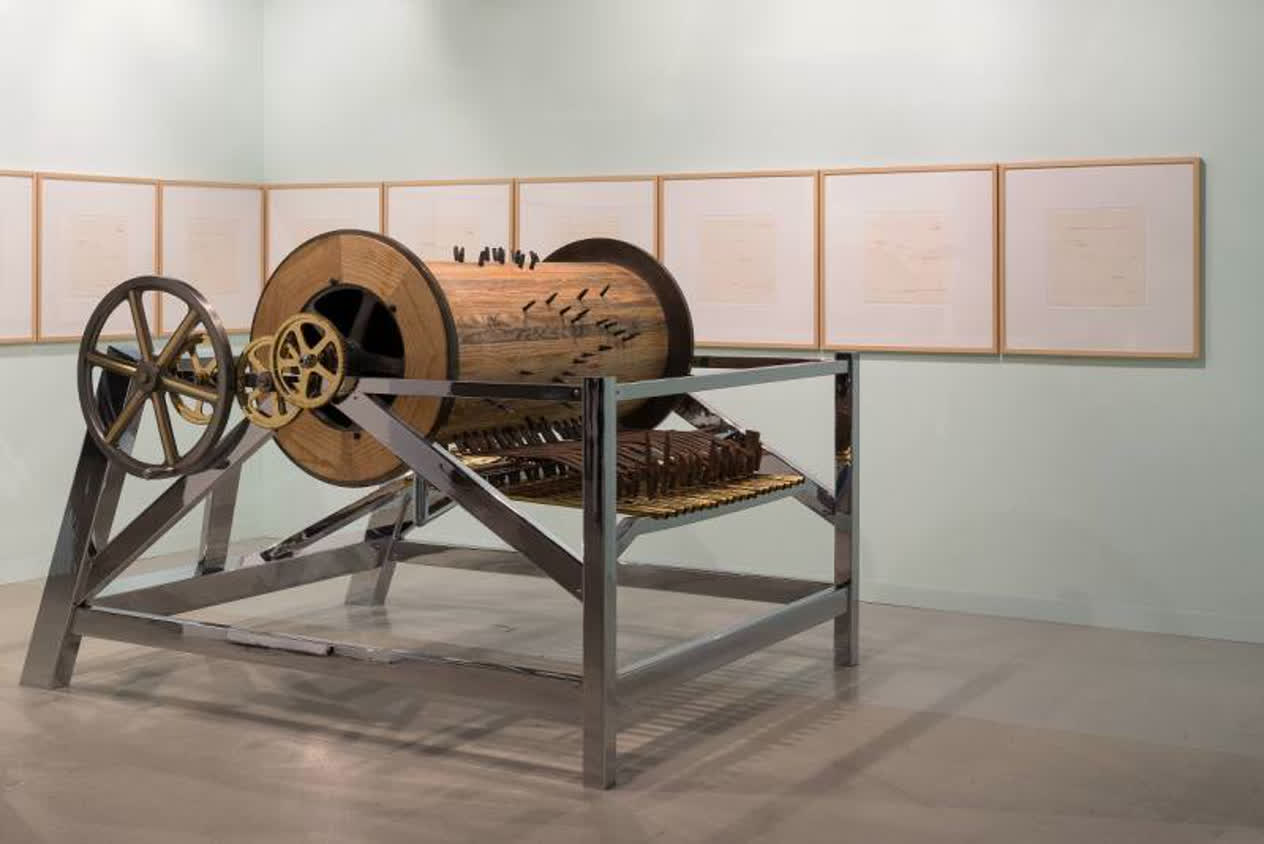
© Antonio Vega Macotela. Courtesy Labor Gallery

Antonio Vega Macotela’s forceful, research-driven work critically examines provocative topics in social history with an emphasis on power dynamics and the exchange value of human labor. The Chisel and the Sinkhole takes the form of an outsize, interactive music box. The work consists of a wooden cylinder outfitted with iron chisels that serve as the teeth of the music box. As the cylinder rotates, the chisels push down on a set of hammers, causing them to strike metal pipes in sequence, resulting in a series of clanging tones that make up a delicate melody.
The melody belongs to a song that was famously incanted by Black slaves around the time of a violent uprising in a Colombian mining town during the last decade of the 18th century. In the same decade as the uprising, Swiss watchmaker Antoine Fabre invented the classic European music box. Often displaying fine craftsmanship, this object was a highly sought-after luxury item throughout the Age of Enlightenment. Amplified to a surrealistically monumental scale, Macotela’s version puts issues of class and labor into high relief, evoking the historical relationship between colonizer and colonized while concretizing the connection between European wealth and the violent exploitation of non-European bodies in the New World and elsewhere.
Identification
Title
El cincel y el socavón (The Chisel and the Tunnel)
Production Date
2016–17
Object Number
2017.219
Credit Line
Collection Pérez Art Museum Miami, museum purchase with funds provided by PAMM’s Collectors Council
Copyright
© Antonio Vega Macotela. Courtesy Labor Gallery
https://live-pamm-dot-org.pantheonsite.io/en/artwork/2017.219
Copy artwork link
Physical Qualities
Medium
Wood and metal
Dimensions
65 x 89 x 96 inches
Visual Description
El cincel y el socavón or The chisel and the sinkhole is a wood and metal sculpture that stands approximately five and a half feet tall, seven feet wide, and eight feet deep. For reference, standard ceiling height in homes is eight feet tall. This sculpture is a larger-than-life interactive classic music box. It consists of a large, raw wooden drum at its center that spans the entire width of the sculpture. The wooden drum’s diameter alone appears to be three or four feet across. Similar to a printing press, the drum is turned with a trio of polished brass and metal wheels to its left. The sculpture is supported by an industrial metal frame with a shiny or glossy finish. Iron chisels poke out of the wooden drum like thorns in a sequential pattern. As the wooden drum rotates clockwise, the chisels turn with it and push down on a set of iron hammers below. This causes the hammers to strike a bed of metal pipes cut at equal lengths, which then plays a delicate melody despite its hefty material.