John Rivas Yo Sola Lo Hice (I Did It Alone) 2020
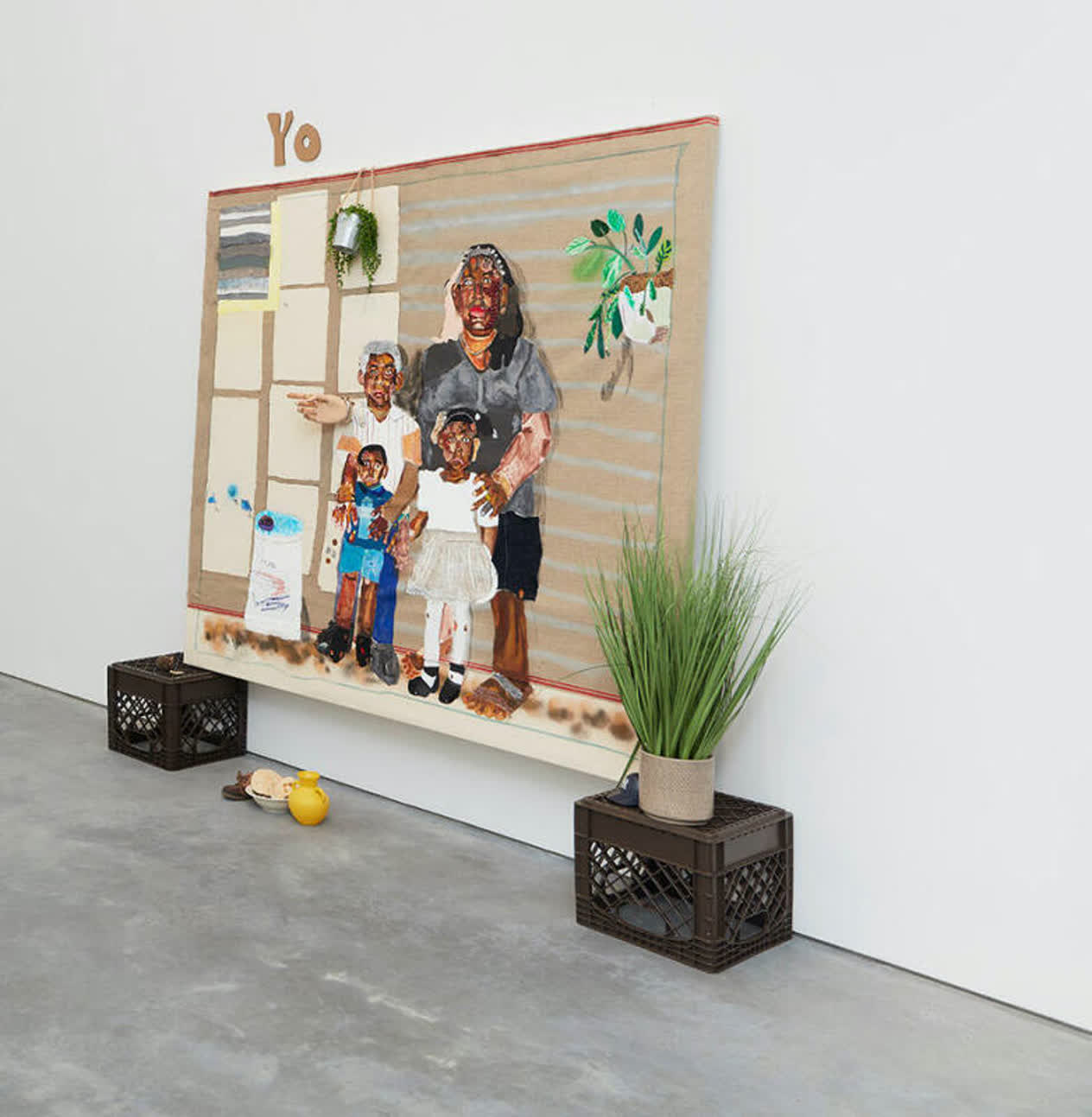
© John Rivas. Courtesy Ross + Kramer Gallery. Photo: Farzad Owrang

John Rivas creates highly expressive figurative paintings that examine socioeconomic, racial, and cultural dimensions of the lives of immigrants. His work portrays the lived experiences of close and distant family members. The thick, rough brushstrokes he employs imbue his works with raw energy, a painting style that reflects the hard work at farms, construction sites, and other labor-intensive contexts where many of his family members work.
Yo Sola Lo Hice depicts the artist’s aunt and cousins in El Salvador. As in much of his work, Rivas incorporates three-dimensional objects as signifiers. He draws out the contours of his family members’ faces with affixed beans—a dietary staple for most Salvadorians, regardless of social class. Several other elements bear talismanic qualities: a child’s shoe, a bowl of tortillas, and a small water vessel represent life’s essentials. A Yankees baseball cap represents the American dream, while a stuffed mouse and fake houseplants evoke the family’s modest home in the countryside. The title alludes to his aunt’s accomplishment in ensuring the survival of her children through her own labor and determination.
Identification
Title
Yo Sola Lo Hice (I Did It Alone)
Production Date
2020
Object Number
2020.211
Credit Line
Collection Pérez Art Museum Miami, museum purchase with funds provided by PAMM’s Collectors Council, in honor of Susana and Alberto Ibargüen
Copyright
© John Rivas. Courtesy Ross + Kramer Gallery. Photo: Farzad Owrang
https://live-pamm-dot-org.pantheonsite.io/en/artwork/2020.211
Copy artwork link
Physical Qualities
Medium
Milk crates and mixed media, beans, and corn on linen mounted on canvas
Dimensions
81 1/2 x 79 inches
Visual Description
Yo Sola Lo Hice (or I Did It Alone) by John Rivas is a mixed media work on canvas accompanied by an installation with a variety of everyday objects. Overall, the work measures nearly seven feet tall by six and half feet wide. The work on canvas depicts the artist’s aunt and cousins in El Salvador painted with loose, wet, inky browns and some parts that are drawn and others incomplete. They all stand together in the center of the frame, as if posing for a family photo against an abstract background made with sewn and collaged elements. In the foreground, the aunt stands slightly to the right and is the tallest figure in the group. She stares directly at the viewer with a relaxed expression. She has one arm resting on the right shoulder of a small girl who stands in front of her, while having another rest on an older boy’s shoulder to her left. Her hand on the left is three-dimensional, as if made from brown plastic. It comes off the canvas, palm facing the viewer with an index finger pointing towards something that is outside the frame. The head of the girl who stands in front barely reaches the bottom of the aunt’s chest. The girl is looking directly at the viewer with slightly wide eyes and blank expression. Her black curly hair is styled into pigtails, and she wears a white short-sleeve shirt with a gray skirt, white stockings and black Mary Jane shoes. To the left of the girl is an even smaller boy, whose hand she holds while hiding her other hand behind her back. The boy is most likely the youngest of the children as he is the shortest, with a head just reaching the tops of his sister’s shoulders. He also looks directly at the viewer and has short, black hair. He wears a royal blue shirt with matching shorts and black shoes. An older boy stands behind the little boy and wraps his arms protectively around his shoulders. The little boy wraps a hand around one of the older sibling’s protective arms. The older boy also has a blank expression. He has slightly longer hair than the younger boy, it appears mostly white with a curly texture drawn in with pencil. He is wearing a short sleeve shirt with a collar that is white with black pinstripes and caramel-colored sleeves, blue jeans and black sneakers. The family’s faces have all been affixed with black beans in lieu of painted shadows. Behind them, there’s a raw linen background with neutral gray spraypainted horizontal stripes. To the left of the family are nine rectangular raw canvas panels sewn on top of the linen unevenly, appearing to suggest windows. The panel on the top left is quilted with gray horizontal stripes of fabric, as if it were a grate or air vent. Collaged on top of these sewn canvas panels, is another sewn element in the shape of an oil drum. It seems to contain water, as its round top is painted with bright cerulean blue that looks like the surface of a swimming pool. The floor by their feet is raw canvas, dotted with short marks of spray-paint in several shades of brown. To the right of the family, there is an indoor plant hanging off an imaginary wall painted with flat and graphic bright greens that looks almost as if it were printed. Above, hanging from the frame itself, is an actual bucket with a string of pearls plant. On the wall behind frame and above the planter hovers a hand sewn pair of handwritten brown block letters spelling out “Yo” or “I” in Spanish. The entire image is propped up off the floor with a pair of black milk crates on either side, acting as feet. On the milk crate to the right, there is a planter with a long, slender type of grass, accompanied by a shiny black plastic hat with the New York Yankees logo. On the milk crate to the left, there is a small stuffed mouse. On the floor, in front of canvas, there’s a single worn brown leather shoe, a bowl filled with tortillas, and a small yellow vase or pitcher.